
A proprietary model calibrated for high-resolution data
We calibrated our turbulence model specifically for HRRR. We do not reuse assumptions designed for older, coarser weather grids.
Your trip is already planned. This is preparation for the experience ahead.
A forecast that accounts for the full journey
Your aircraft will travel through changing weather over time and at altitude. Knowing the airport forecast alone cannot tell you what to expect along the route.
A more complete picture considers where the aircraft is expected to be and when it is expected to be there.

01 / The question
A single map frame cannot answer what conditions are expected when the aircraft reaches each part of its route.
FlightPath Sync is our method for connecting the forecast to the journey.
02 / The forecast
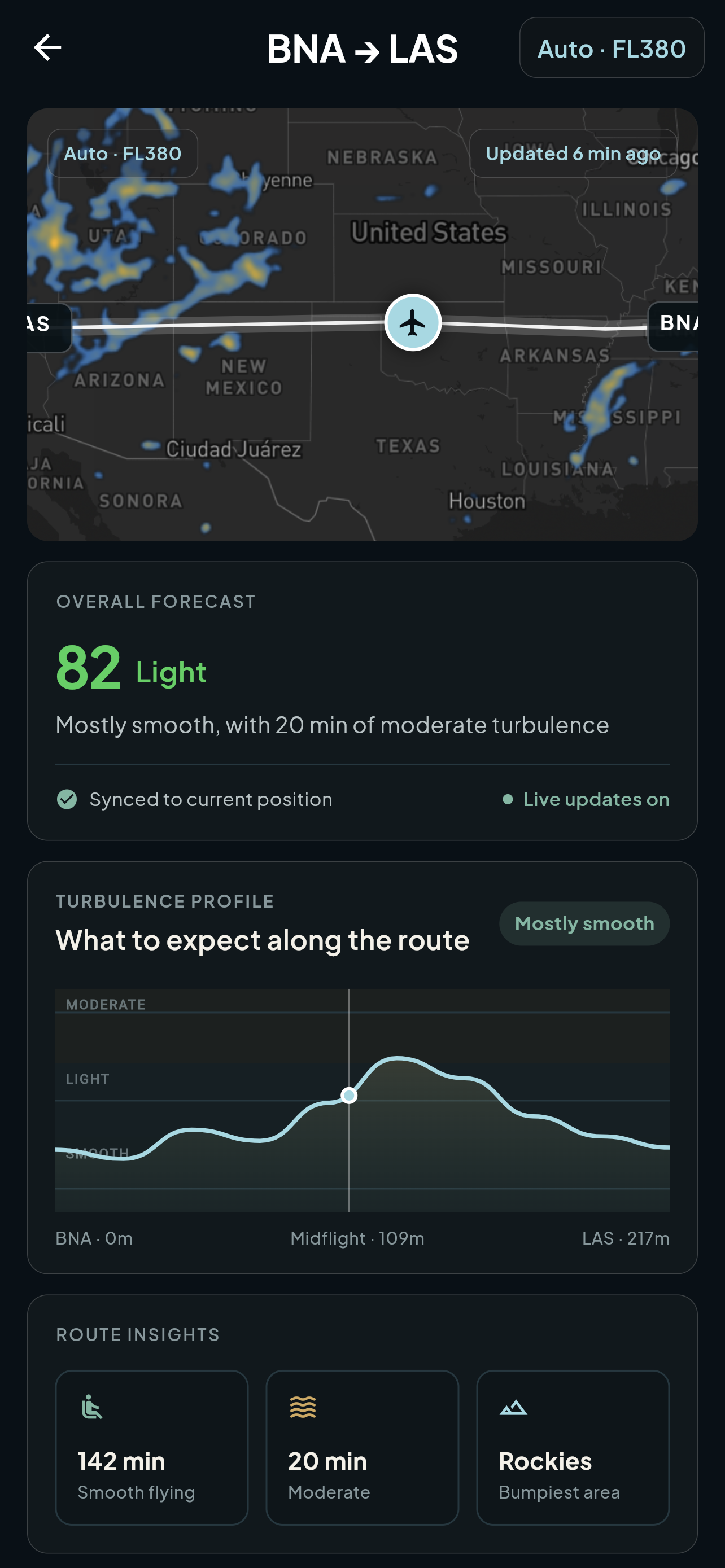
FlightPath Sync follows the predicted journey through successive forecast hours and flight levels, then translates that path into a clear passenger-facing forecast.
Carefully built and calibrated
Inflight Score is built on NOAA’s real-time, 3 km HRRR weather model—high-resolution atmospheric data updated every hour for the continental United States.
We do not substitute an airport forecast for the journey or apply one frozen weather snapshot to the entire route.
We calibrated our turbulence model specifically for HRRR. We do not reuse assumptions designed for older, coarser weather grids.
FlightPath Sync aligns expected position, time, and altitude so the forecast changes as the flight moves through the atmosphere.
We show what the latest forecast supports, keep estimated conditions distinct from observations, and never turn missing data into a confident answer.
03 / What changes
Review the smoothness score, approximate time in each condition, and the turbulence profile across the full route. When fresh live position is available, the app can focus the forecast on what remains ahead.
A forecast is information, not a guarantee. Weather can change and actual conditions may differ. Inflight Score is designed to help passengers prepare for the experience of a flight, not to support operational aviation decisions.
Your next flight
Add the scheduled flight you are taking and see expected conditions along its route.